
“Going viral” sounds like magic. It isn’t. Reach on short-form is mostly a function of a few measurable things, and you can engineer for all of them. You still won’t hit every time — nobody does — but you can dramatically shift the odds. Here’s what actually matters.
The algorithm is a retention machine
Every major short-form platform optimises for roughly the same thing: watch time and completion, amplified by shares. It shows your video to a small test audience, watches how they behave, and expands reach if the signals are strong. So “make a viral video” really means “make a video that holds attention and gets shared.” Everything below is a lever on those two.
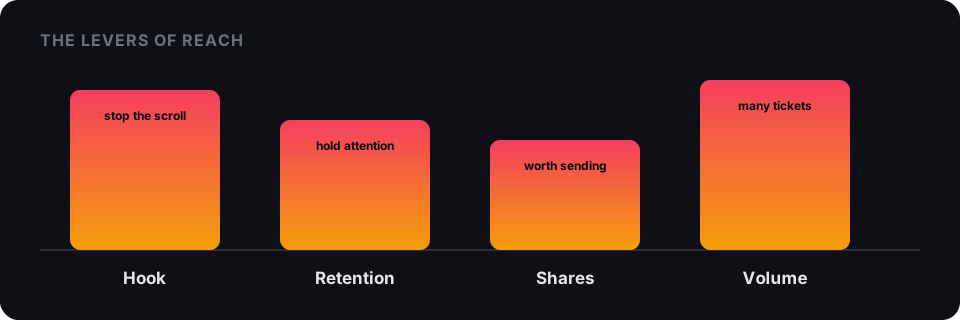
Lever 1: the hook (first 1–2 seconds)
If people scroll past, nothing else matters. The hook has to stop the thumb instantly:
- Make a promise: “The 3 habits that fixed my sleep.”
- Open a loop: “This is why your videos aren’t getting views…”
- Lead with the payoff: put the most striking clip or claim first, not last.
- Use text. On faceless content especially, a bold on-screen headline is the hook. Say the promise and show it.
Rewrite your hook five times. It’s the highest-leverage sentence you’ll write all day.
Lever 2: retention (the messy middle)
Holding attention after the hook is a craft:
- Cut hard and often. Dead air is death. Trim every pause.
- Keep it moving visually — motion, captions appearing, B-roll under the audio.
- Front-load value, delay resolution. Answer the hook’s question at the end, so people stay to get it.
- Keep it short enough to finish. A completed 20-second video beats an abandoned 60-second one. Completion is the signal.
Lever 3: shareability
Shares are the strongest amplifier there is — a share is a person putting their reputation behind your video. Engineer for it:
- Relatable: “send this to someone who…”
- Useful: something worth saving or forwarding.
- Emotional: funny, awe, mild outrage, satisfaction.
- Debatable: a take people want to argue about in the comments.
If nobody has a reason to send it to a friend, it won’t travel far.
Lever 4: volume and iteration
Here’s the uncomfortable truth: you cannot predict which video pops. So stop trying to. Post consistently, give the algorithm many shots, and treat each video as an experiment. When one over-performs:
- Find why — the hook? the topic? the format?
- Clone the winner. Make several more in the same shape.
- Retire what consistently flops.
Most “overnight” viral creators posted for months first. Volume is how you buy enough lottery tickets for luck to show up.
Lever 5: format familiarity
Proven formats travel because viewers already know how to consume them — ranked countdowns, post-card captions, split-screen with B-roll, text-on-clip facts. Working inside a known format lets you focus all your creativity on the hook and the pick, which is where virality is actually decided.
Engineering the odds
- Source proven material. Start from clips already performing in your niche rather than guessing cold.
- Template the production so you can ship at volume without burning out.
- Batch and schedule so posting is a habit, not a decision.
- Read retention and shares, ignore vanity likes, and clone what works.
Virality is a process, not an event. Build the process — hook hard, hold attention, earn shares, post at volume, clone the winners — and the hits stop feeling like accidents.
Shortmaker gives you the production half of that process: find what’s working, wrap it in a proven format, and export a week of shorts in one sitting.