
Faceless content is the most accessible way to build an audience right now. No camera confidence, no on-camera talent, no studio — just a niche, a format, and consistency. But “faceless” isn’t a shortcut to easy; it’s a shift in where the work goes. Here’s how to actually do it.
1. Pick a niche you can feed forever
The single biggest predictor of whether a faceless channel survives is whether you can keep feeding it. Pick a niche with an effectively infinite supply of raw material and a clear audience:
- Motivation & mindset — discipline, stoicism, money psychology.
- Educational micro-content — history facts, science explainers, “things you didn’t know”.
- Curated compilations — sports, comedy, oddly-satisfying, fails.
- Commentary over gameplay or B-roll — the classic “brain-off” scroll format.
The test: can you find or produce ten new clips this week without straining? If not, the niche is too narrow.
2. Commit to one repeatable format
Viewers subscribe to formats, not videos. A format is a template someone can recognise in half a second: the ranked countdown, the post-card with a bold caption, the split-screen with subway-surfers B-roll underneath, the text-on-clip fact drop. Pick one and run it into the ground before you add a second. Repetition is a feature — it’s what makes your channel a brand instead of a pile of uploads.
3. The hook is 80% of the job
Short-form lives or dies in the first second. On a faceless channel the hook is usually text: the header on a ranking, the caption on a post card, the first line of the on-screen fact. Write it like a headline. Make a promise, create a gap, or state something mildly controversial — then let the clip pay it off.
Everything else — music, transitions, fonts — is polish. The hook is the product.
4. Systematise sourcing and production
This is where most faceless creators quietly quit: sourcing clips and rebuilding the same edit every day is exhausting. So don’t do it by hand.
- Use a discovery tool to find clips that are already proven in your niche, instead of hunting across three apps.
- Use a templated format so production is fill-in-the-blank, not start-from-scratch.
- Batch. Make ten at once on one sitting, not one per day.
The goal is a pipeline where the only decision left is taste — which clip, which hook — and the machine does the assembly.
5. Post at volume, then read the data
Faceless growth is a numbers game. You are running experiments, and you need enough of them to learn. Post daily if you can. Watch retention and shares, not likes. When something over-performs, don’t celebrate — clone it. Make five more in the same shape. The algorithm rewards consistency of format, and your audience rewards you for giving them more of the thing they already liked.
6. Stay on the right side of the line
Reposting others’ clips wholesale is a fast way to get demonetised or struck. Add value: recontextualise, compile, comment, caption, transform. Credit sources. Lean toward material that’s fair to reuse, and build enough of your own framing that the result is genuinely yours.
The faceless flywheel
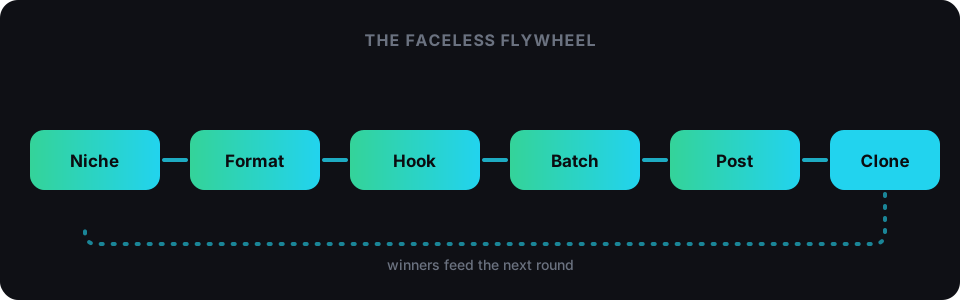
Niche → format → hook → batch → post → clone the winners. That’s the whole loop. The creators who win aren’t the ones with the best single video — they’re the ones who built a system they can run every day without hating it.
That’s exactly what Shortmaker is built to be: the pipeline between “I found some clips” and “I posted a week of shorts”.